 Merlin swap
 quote review and output confirmation
Merlin swap converts a selected input asset into a quoted output on Merlin Chain through a connected wallet. Before confirming, compare the token pair, input amount, quoted output and slippage setting with the exchange you intend to make. The wallet should show the expected network and gas charge; confirm that the account can cover it with the displayed gas asset. After submission, use the transaction status and received balance to reconcile the quote with what reached the wallet.
Updated:
In short: Review the token pair, quoted output, slippage and network fee before signing, then match the confirmed transfer to the wallet balance.
Immediate swaps and price-conditioned orders
An immediate pool swap seeks execution from available liquidity after the wallet signs the transaction. Its quote reflects the pool state at that moment. The displayed amount does not reserve liquidity while the request waits for confirmation.
When that control is available, a limit order records a price condition and may remain open until the condition can be satisfied. Its target value should not be compared with an immediately executable quote as though both represented the same state. Order availability and cancellation controls must be visible on the connected network before they can be used.
Bridging also belongs to a separate path. If an asset starts outside Merlin Chain, its arrival on the intended account is a prerequisite for a same-chain exchange. The bridge transfer creates the starting balance; it is not the quoted swap itself.
How do the quote, liquidity and wallet approval fit together?
Current pool state determines the quoted relationship between the selected input and estimated output. The wallet separately authorizes the contract action that attempts to execute it. A larger input may execute across a wider price range, increasing price impact. The slippage setting limits how far execution may move from the accepted quote.
Wallet connection supplies the account and network context. A contract token may also require an allowance before the swap contract can use it. The later signature submits the exchange transaction. Once broadcast, that transaction can consume gas even if contract execution reverts. Quote calculation, token permission and execution are separate states, so completing one does not prove that the others occurred.
Reading the quote before signing
Before signing, match the exchange direction, both amounts and the execution tolerance. Each field answers a different question about the requested transaction.
| Quote parameter | Value to inspect | Why it can change | Required state |
|---|---|---|---|
| Input side | Selected token and entered amount | The token or amount is edited | The connected account holds that asset on Merlin Chain |
| Output side | Destination token and estimated amount | Available liquidity or the executable path changes | A supported path has enough liquidity for a quote |
| Slippage control | Displayed execution tolerance | The setting is edited or the quote refreshes | The tolerance matches the intended output boundary |
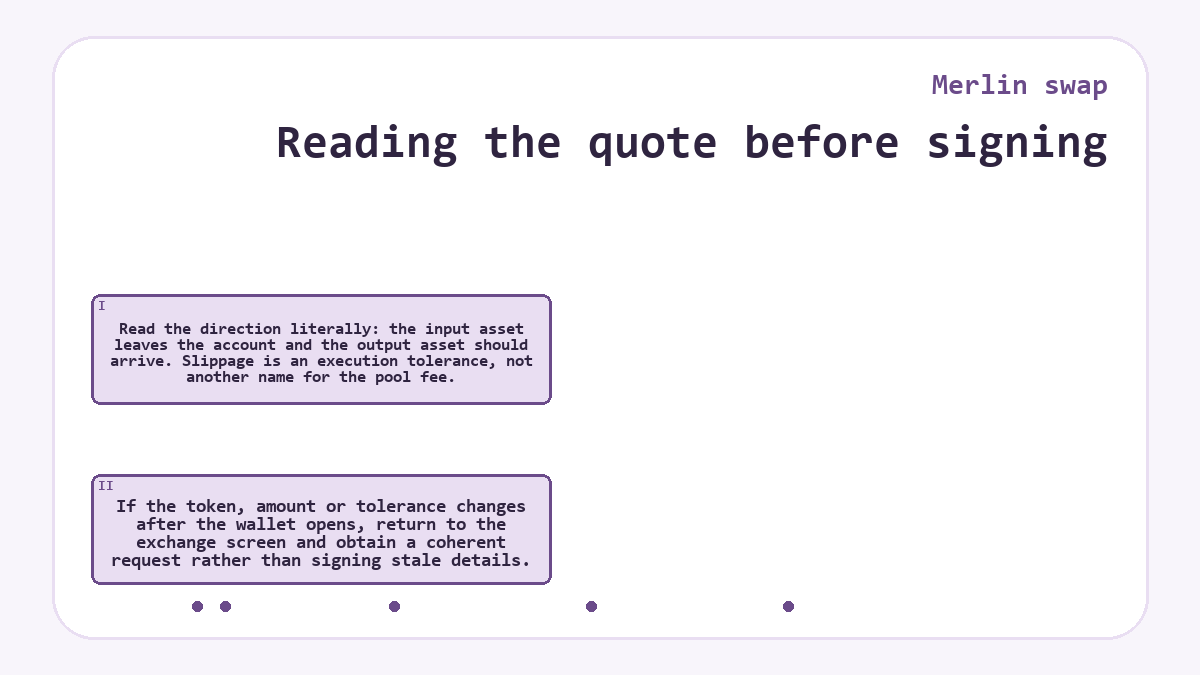
Read the direction literally: the input asset leaves the account and the output asset should arrive. Slippage is an execution tolerance, not another name for the pool fee. If the token, amount or tolerance changes after the wallet opens, return to the exchange screen and obtain a coherent request rather than signing stale details.
A newly refreshed quote replaces the earlier estimate.
Cost inputs around the quoted output
A quote and a gas estimate answer different questions. Review both before the wallet signature.
The estimated output reflects the exchange relationship available through the selected pool or path. Pool fees and price impact can affect that amount, while the wallet presents network gas separately. Merlin Chain uses native BTC as its primary gas asset. An account abstraction wallet flow may also offer MERL as the gas asset. No fixed gas figure remains reliable because the estimate can move with network demand and transaction complexity.
A missing gas balance can block execution even when the account holds enough of the input token. The reverse is also possible: gas may be available while the selected token balance is too small. Compare each requirement with the asset that pays it. Do not subtract gas from the quoted output unless the displayed transaction explicitly uses that same asset and mechanism.
Approval and execution states
Wallet prompts divide permission from execution, so each request needs to be read on its own terms. A completed approval does not mean that an exchange has occurred.
Before the swap
Check the active account, Merlin Chain network and spending asset before authorizing any contract interaction. These details establish which balance the contract can access.
Token permission
When the input is a contract token, the swap contract may need an allowance. Approval authorizes access up to the scope displayed by the wallet. An existing allowance can remove the need for a fresh approval. A broader permission than expected is a reason to stop and inspect the request, since an allowance may persist after the attempted exchange.
Transaction signature
The swap signature should follow any required approval and remain on the same network. Compare the displayed input value, account and contract interaction with the prepared quote. Some wallets cannot decode every output field, but incomplete decoding does not justify signing an unclear request. Return to the exchange interface if the transaction context no longer matches.
After submission
A broadcast transaction first enters a pending state. Avoid submitting the same exchange again while that state remains unresolved. A successful receipt commits the resulting state change, while a reverted receipt produces no swap output and may still consume gas. The transaction identifier connects the wallet request, ledger status and later token transfer, making it the correct record for reconciliation.
Matching the confirmed transfer with the wallet
Confirmation requires a successful transaction that sends the expected output to the intended account. Compare the network, receiving address, receipt status and recorded movement of the output asset. A success animation alone does not establish the amount received. Wallet token lists can lag or hide a contract token, while the transaction record can identify its contract and recipient.
The final amount may differ from an earlier estimate within the accepted slippage boundary because liquidity can change before inclusion. Gas belongs to a separate part of the transaction and normally should not be deducted from the destination token when reconciling output. Compare the specific transfer with its quote rather than using a later wallet total that may include unrelated activity.
Reasons an expected balance may not appear
A missing or different balance does not identify the cause by itself. Several transaction states can produce a similar wallet display:
- The swap remains pending, so no final output exists yet.
- The execution reverted after the price moved beyond the accepted boundary.
- The receipt belongs to another account or network.
- The output token is hidden or has not been indexed by the wallet.
- An approval succeeded, but the separate swap transaction was never submitted.
Begin with the transaction identifier and determine whether a swap transaction exists. If only an approval appears, there is no exchanged output to find. A pending transaction calls for waiting rather than repeating the request. A failed receipt explains why the quoted amount did not arrive. For a successful receipt, inspect the transfer details before treating a display problem as an execution problem.
Conditions for continuing, waiting or stopping
A missing prerequisite changes the next action. Continue only when the account, network, pair, direction, quote and gas requirement agree. Wait when the quote cannot refresh or an earlier transaction remains pending. Stop when the wallet shows a different asset, an unexpected permission, an unacceptable output boundary or a network that does not match the prepared exchange.
Network identity deserves an explicit check because the same token symbol can appear on several chains. A readable network name helps, but the numeric identifier provides a stronger comparison when the wallet exposes it. Merlin Mainnet uses chain ID 4200.
Merlin swap: what people ask
Can a Merlin swap proceed without a fresh token approval?
A Merlin swap can proceed without a fresh approval when the contract already has adequate allowance or the input is the network's native asset. A contract token with insufficient allowance usually needs a separate permission transaction first. Read each wallet request independently because approval permits token access, while the later signature submits the exchange.
Why can a confirmed transaction show no visible output balance?
A successful receipt can appear before a wallet interface displays the received token. Confirm that the receipt belongs to the expected account and network, then inspect the recorded movement of the output asset. A contract token may be hidden or waiting for the wallet index to update. Add a token display only after matching its contract address with the successful transaction.
Which balance pays the network fee?
The gas balance pays the network fee separately from the token being exchanged. Merlin Chain primarily uses native BTC for gas, while an account abstraction wallet flow may allow MERL to pay it. The wallet should identify the selected gas asset before signing. Holding enough input tokens does not compensate for a missing balance in the required gas asset.
Does a quote reserve the displayed output?
A swap quote does not reserve the displayed output while the transaction waits for a signature or ledger inclusion. Available liquidity can change during that interval, so the interface may refresh the estimate. Slippage protection defines an acceptable execution boundary; it does not freeze the pool state or guarantee that the transaction will execute.
Can a completed on-chain swap be reversed?
A confirmed on-chain swap cannot normally be reversed through the exchange interface because the confirmed transaction has already changed ledger state; if the wrong token, amount or account appears before signing, reject the request, and if the transaction is still pending, inspect its status before attempting any replacement or repeat submission.